 Sign in
Displaying 46 to 60 of 90 Publications
Watering Vegetable and Flower Gardens
by Ward Upham
MF2804
Generally, flower and vegetable beds should be watered when the top several inches of soil is dry. Dig down 2 to 4 inches with a trowel to determine if soil needs additional water. 2 p.Published Date: Jan 2008


Fertilizing Gardens in Kansas
by Ward Upham
MF2320
Covers soil testing, fertilizer composition and application rates, information on adjusting soil pH, and more. 12-page, color.Revision Date: Jan 2018
Making Compost: A Beginner’s Guide
by Ward Upham
MF1053
Instructions on how to make compost from organic waste, and use it to improve garden soil. 4 page, color.Revision Date: May 2019
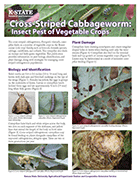
Cross-Striped Cabbageworm: Insect Pest of Vegetable Crops
MF3505
Information to help identify and manage this insect pest that feeds on cole crops such as broccoli, Brussels sprouts, and cabbage, and on turnips and leafy-green vegetables. 2-page, color.Published Date: May 2020
Insect and Mite Pests of Vegetable Gardens
MF3480
How to detect, identify and manage insect and mite pests in vegetable gardens. Includes photos of common pests and information on susceptible host plants. 8-page, color.Published Date: Mar 2020
Squash Bug, Home and Horticultural Pests
by Raymond A. Cloyd James R. Nechols
MF3308
Identification and management of this major insect pest of field and garden-grown squash and pumpkins. 4-page, color.Published Date: Jul 2016
Squash Vine Borer, Home and Horticultural Pests
by Raymond A. Cloyd James R. Nechols
MF3309
Tips for home gardeners on how to identify and manage this damaging pest of cucurbit plants such as squash, pumpkin, cucumber, and muskmelon. 2-page, color.Published Date: Jul 2016

Integrated Pest Management in Greenhouses and Herbaceous Nurseries
by Raymond A. Cloyd James Quinn David Trinklein
MF2892
Integrated pest management (IPM) involves use of cultural, physical, biological, and chemical methods to manage insect and mite pests. Includes inspection, scouting and monitoring. 8-page, color.Published Date: Jul 2009

Garden Templates and Plant Choices for Kansas School Gardens
MF3590
Use garden templates and the plant information to plan a school garden that will provide a variety of learning opportunities as well as fresh produce. Includes templates for spring, fall, summer, and extended season gardens, as well as a wide variety of plant choices. 168 pages, color.Published Date: Feb 2022
Use of Sanitizers in Postharvest Water
MF3647
Postharvest water refers to water used for rinsing, cooling, or icing harvested produce. It also includes water used for handwashing and cleaning food contact surfaces. Food Safety Modernization Act (FSMA) Produce Safety Rule (PSR) sets a standard for preventing contamination from agricultural water for post-harvest use. 4 pages, color.Published Date: Dec 2023
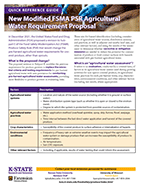
New Modified FSMA PSR Agricultural Water Requirement Proposal
MF3642
Fact sheet outlines proposed changes and steps producers may need to take to change pre-harvest agricultural water requirements for covered produce (fruit and vegetables other than sprouts) to comply with the Food Safety Modernization Act (FSMA) Produce Safety Rule (PSR). 2 pages, color.Revision Date: Apr 2024
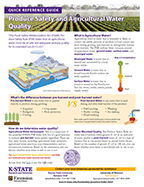
Produce Safety and Agricultural Water Quality
by Londa Nwadike Yeqi Zhao Olivia Haley
MF3643
The Food Safety Modernization Act (FSMA) Produce Safety Rule specifies that all agricultural water must be safe and of adequate sanitary quality for its intended use. This fact sheet outlines the basics of water quality and produce safety and includes a guide to interpret your water quality test. 2 pages, color.Published Date: Dec 2023
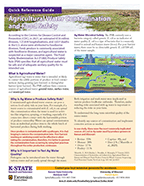
Agricultural Water Contamination and Food Safety
MF3645
Fresh produce is commonly associated with foodborne illnesses, and agricultural water is suspected as a major causative agent. This fact sheet outlines the food safety risks associated with agricultural water and how to address water contamination on the farm. 2 pages, color.Published Date: Dec 2023
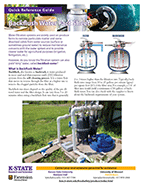
Backflush Water Fact Sheet Sheet
MF3646
Fact sheet outlines the concerns associated with backflush water and how to mitigate risks. Water filtration systems are used on produce farms to remove particulate matter and some dissolved solids. A filtration system can yield “dirty” water, called backflush water. 2 pages, color.Published Date: Dec 2023
Approaches for Treating Ag Water for Postharvest Use
MF3641
The Food Safety Modernization Act (FSMA) Produce Safety Rule specifies that all agricultural water must be safe and of adequate sanitary quality for its intended use. This fact sheet outlines treatments methods to ensure safe agricultural water. 2 pages, color.Revision Date: Apr 2024
Displaying 46 to 60 of 90 Publications
