 Sign in
Displaying 1 to 15 of 73 Publications
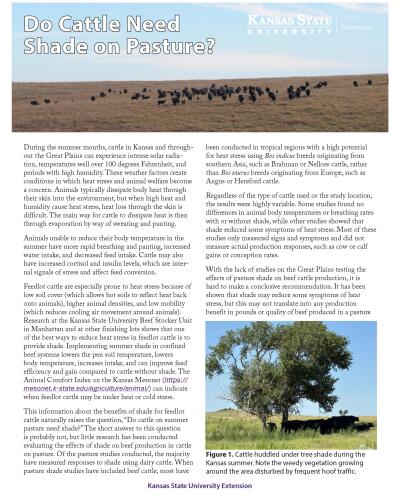
Do Cattle Need Shade on Pasture?
by Keith Harmoney Emma Briggs A. J. Tarpoff
MF3742
This publication examines some of the variables related to providing shade to cattle grazing on the High Plains. 4 pages, color.
Published Date: Jul 2026


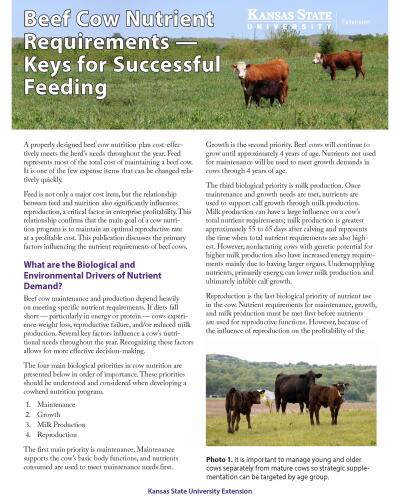
Beef Cow Nutrient Requirements — Keys for Successful Feeding
by Jason M. Warner Justin Waggoner
MF3726
This publication discusses the primary factors influencing the nutrient requirements of beef cows. 4 pages, color.
Revision Date: Jul 2026
Body Condition Record Book
by Justin Waggoner Sandy Johnson
MF3277
A tool beef cattle producers can use to collect and track body condition throughout the year. 24-page, color cover.
Revision Date: Dec 2025
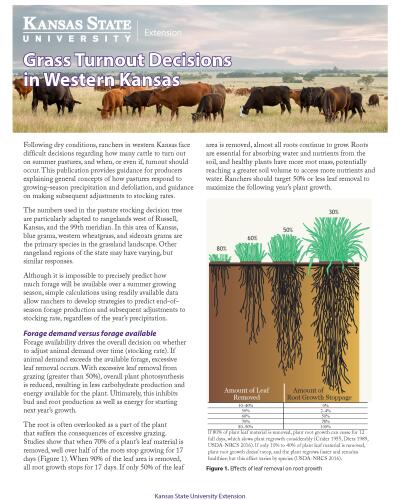
Grass Turnout Decisions in Western Kansas
by Helen Giefer et al.
MF3716
This publication provides guidance for producers explaining general concepts of how pastures respond to growing-season precipitation and defoliation, and guidance on making subsequent adjustments to stocking rates. Color, 4 pages.
Published Date: Apr 2026
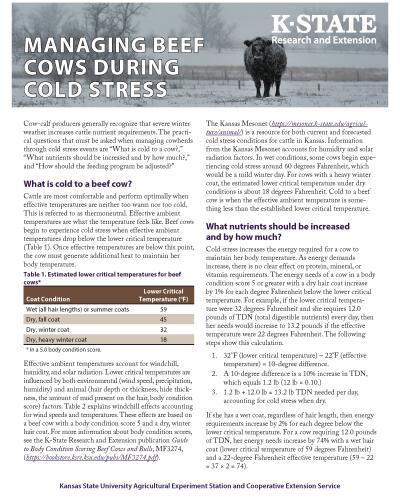
Managing Beef Cows During Cold Stress
by Jason M. Warner Justin Waggoner
MF3684
This publication explores what is cold to a cow?, What nutrients should be increased and by how much?, and how should the feeding program be adjusted? 4 pages, color.
Published Date: Jun 2025
Managing Spring Planted Cover Crops for Livestock Grazing under Dryland Conditions in the High Plains Region
by Joe Brummer Sandy Johnson et al.
MF3443
Recommended practices for species selection, adjusting stocking rates, and grazing. Produced in collaboration with extension specialists and research scientists at Colorado State University and University of Nebraska. Colorado's page for this publication: Managing Spring Planted Cover Crops...
Published Date: Dec 2018
Measuring the Effects of Dry Matter in Beef Cattle
by Jason M. Warner Brandon J. Fraser
MF3676
This publication covers how dry matter is determined on the farm or ranch, how variation in DM influences the composition of a diet, and the implications DM can have on the economics of a nutrition program. Color, 4 pages.
Published Date: Mar 2025
Importance of Dry Matter in Beef Cattle Diets
by Jason M. Warner Brandon J. Fraser
MF3675
This publication outlines what dry matter is, how the terms DM and as-fed (AF) are determined, the appropriate usage of these terms, and examples of the typical DM of feedstuffs. Although this publication is written regarding beef cattle nutrition, the fundamentals discussed apply to feeding scenarios for dairy cattle and small ruminants, in addition to any species in which feedstuff DM content varies. Color, four pages.
Published Date: Mar 2025
Environmental Considerations for Composting Livestock Mortalities
by Ron Graber Joel M. DeRouchey
MF2729
This publication addresses methods and considerations of composting livestock mortalities. 4 pages, b/w.
Revision Date: Feb 2024
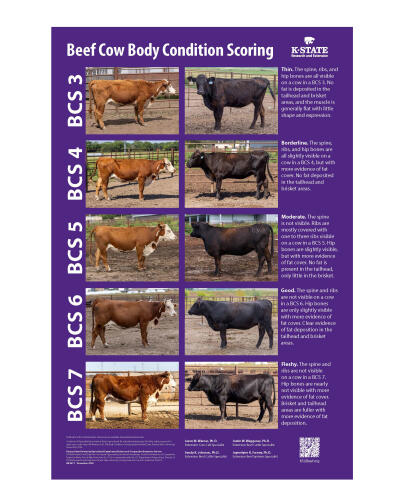
Beef Cow Body Condition Scoring
by Jason M. Warner et al.
MF3677
An illustrated poster that shows how cattle look at different body condition scores as they gain weight, from thin cattle at BCS 3 to fleshy ones at BCS 7. Color, 20 x 30 inch poster. Free, but the order limit is one poster.
Published Date: Dec 2024
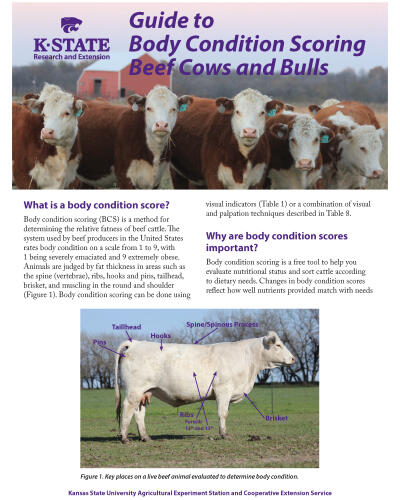
Guide to Body Condition Scoring Beef Cows and Bulls
by Jaymelynn Farney et al.
MF3274
Information for producers on how and why to use body condition scoring. 8-page, color.
Revision Date: Oct 2024
FDA-Approved Injectable Beef Cattle Antimicrobials
MF2848
Describes medications, methods, and dosage to treat bacterial and rickettsial diseases that infect cattle. Includes withdrawal times to avoid drug residue in cattle slaughtered for meat. 4-page, color.
Published Date: Sep 2024
Coccidiosis
MF2209
Coccidiosis is an intestinal disease caused by protozoa, primarily affecting cattle aged 1 month to 1 year, though all ages can be infected. The disease is caused by Eimeria species, with Eimeria bovis and Eimeria zuernii being the most common. The protozoa invade intestinal cells, multiply rapidly, and cause cell rupture. The final stage, oocysts, are shed in feces and are highly resistant to environmental stress. Oocysts contaminate feed and water, and once ingested by other animals, the life cycle restarts. Clinical signs often appear under stress conditions, such as weather changes or overcrowding, but many infected cattle show no symptoms. 2 pages, color.
Revision Date: Sep 2024
Identification and Management of Blue-green Algae in Farm Ponds
by Steve Ensley Scott Fritz Carol Baldwin
MF3065
This publication provides information about blue-green algae, its description, causes, and steps to take if found. Color, 4 pages.
Revision Date: Aug 2024
Enhancing Intensive Early Stocking plus Late-Season Grazing for Stocker Cattle in the Kansas Flint Hills
by Clenton Owensby Walter H. Fick
MF3569
The publication describes a three-year grazing rotation of two years of enhanced intensive early stocking plus late-season grazing followed by one year of season-long grazing at the normal grazing rate. This proved to be a sustainable grazing scheme, which greatly increased profitability for stocker grazing in the Kansas Flint Hills region. 4 pages, color.
Published Date: May 2021
Displaying 1 to 15 of 73 Publications
