 Sign in
Displaying 1 to 8 of 8 Publications
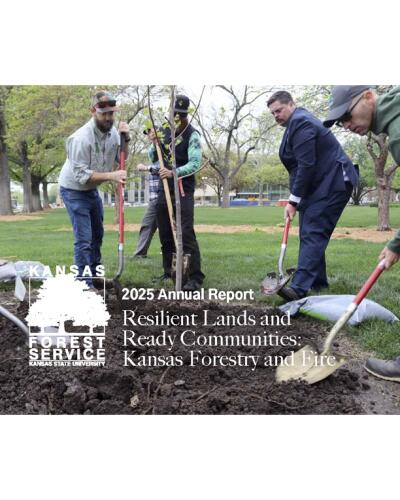
2025 Annual Report, Kansas Forest Service: Resilient Lands and Ready Communities: Kansas Forestry and Fire
RPT119
Report of work by Kansas Forest Service staff for fiscal year 2025. Color, 16 pages.
Published Date: Dec 2025

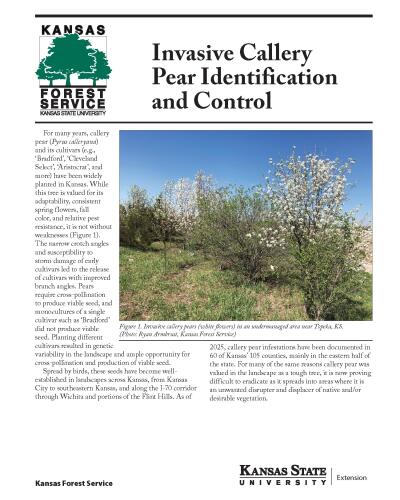
Invasive Callery Pear Identification and Control
MF3570
Learn how to identify and control the invasive callery pear tree. Color, 8 pages.
Revision Date: Nov 2025

Indicator Plants of Forest and Woodland Health in Kansas
by Ryan Armbrust et al.
MF3640
Introduction to identifying herbaceous plants in forests and woodlands of Kansas. Publication helps answer questions about ecological health, and the degree of damage or stability, in woods. 72 pages, color.
Published Date: Dec 2023
Pine Wilt: A Fatal Disease of Exotic Pines in the Midwest
by Mark Gleason
MF2425
This bulletin explains how pine wilt is caused, how it spreads in the landscape, and measures that can be taken to manage the disease. 8-page, color.
Ttile is available for download only, it is not available in print.
Published Date: Feb 2000
Economical Control of Bush Honeysuckle
MF3222
Learn methods of controlling this invasive woody shrub. 2-page, color.Published Date: Apr 2015
Thousand Cankers Disease and Black Walnuts: a Deadly Combination!
MF3167
This publication describes thousand cankers disease and gives tips to control this costly disease’s spread. 2-page, color.Published Date: Jul 2014
Emerald Ash Borer
MF3168
This wood-boring beetle poses a serious threat to native ash trees in Kansas. Potential losses to valuable landscape plants and municipal trees have prompted state agencies to join a national effort to stop the spread of this destructive pest. This publication provides information on pest status, identification, damage, and treatment. 4-page, color.Published Date: Sep 2014
Iron Chlorosis in Trees
MF718
Symptoms, causes and treatment for iron chlorosis: If a tree's leaves turn yellow, this may mean a tree is not able to absorb enough iron from soil, due to high soil pH. Spraying iron solutions on tree leaves can help temporarily, and reducing soil pH helps in the longer term. 4-page.Revision Date: Sep 2003
Displaying 1 to 8 of 8 Publications
